Friday, August 20, 2010

Kamsonga

I just got back from a five day visit to Kamsonga - the village where I'll be living for two years!  I am thrilled with the people, the environment and my house.  Here are some pictures of it:


This is my house! 


My living room.


Spare bedroom


I have a toilet!


This is my shower but I only get cold water so I boil some water, mix it with cold and take a bucket bath in this room. 


Paraffin stove under the chimney. 


My cubbard.  The volunteer who I'm replacing left me spices and other supplies!


This is my bedroom.  I moved a bunch of these boxes into the spare room.


The PCV I am replacing started a small library.


This is the shelf near my bed.


Supplies in the bedroom.


There is a hill behind my house that I climbed. Here's a view of the health center from it.  My house is right by the health center.


Saturday, August 14, 2010

Images of Malawi

This is the first time I've been able to access the internet since I've been in Malawi.  Right now I'm in the Peace Corps office in Lilongwe, the capital of Malawi.  In two days I'll visit Ntchisi for a week - the site where I will be living for two years. 

I am still technically a "Peace Corps Trainee."  I will be sworn in as a Peace Corps Volunteer on September 1 - a day before I turn 27!  Our trainee group is made up of 35 future education and health  Peace Corps Volunteers. 

For the first month of training I lived with a Malawian family in a village called Chipazi in the district of Dedza.  Eight other health trainees also lived in Chipazi and we went to language and technical sessions together.  The language that I am learning is called Chichewa and it is the most widely spoken language in Malawi.  In technical sessions, the other trainees and I learned about participatory community analysis tools, common health problems in Malawi and how to do simple demonstrations about things like mosquito net dipping, nutrition, water sanitation, and hygiene.

Besides this general information, it's hard to know where to begin so I'm going to let my pictures do most of the talking. 


These are some of the members of my homestay family - the Jika family - posing for a picture on their property.  Behind them is the dish drying rack and a shelter for animals. The woman in the front is my host mother and I call her "amayi" (mayi means "mother" and the a is for respect, like "madam").  The girl with the purple dress is my host sister ("achimwali" = sister).  Her name is Talita and she's 18.  The boy is my host brother ("achimwene" = brother).  His name is Asaki and he's 17.  I also have a host father ("abambo" = respectful term for a man and also "father"), and two other host sisters - Ana is 15 and Doro is 9. 


This is Doro, my nine year old host sister, posing by the outdoor cooking fire.  The main cooking fire is indoors in a mud hut. 


Here is an example of a vegetarian Malawian meal.  I ate this a few nights ago at the forestry college in Dedza (also the Peace Corps training site.)  Rice, beans, greens, tomato sauce, and garlic hot sauce with some pineapple on the side - yum!


My host family loves this monster stuffed animal that I brought with me.  They love him so much that they wrote his name on the outside of their cooking hut with a corn husk.  They also often asked me questions (in Chichewa) like "How did Gumpy sleep?" and "Is Gumpy happy today?"  This is my amayi (a poor picture of her) with Gumpy. 


Doro stapped gumpy on her back the way women and girls strap babies. 


Gumpy on the clothes line... he's my version of a "travel gnome..."


...And one more of Gumpy in the window of my homestay hut.


Here's my homestay hut's interior.  It has a wooden frame, mud walls and a thatched roof.


Shoes, water filter, trash box, and pee bucket. 


Paraffin (for my lantern), toiletries, medical kit, jewelery box, rain jacket.


Baby goat!  Also "Irish potatoes."


Some children in the village.


More Chipazi children.


A child taking the kernels off corn with the strange orange creature my mom bought at Target on her lap.


A calf that the Jika family owns.


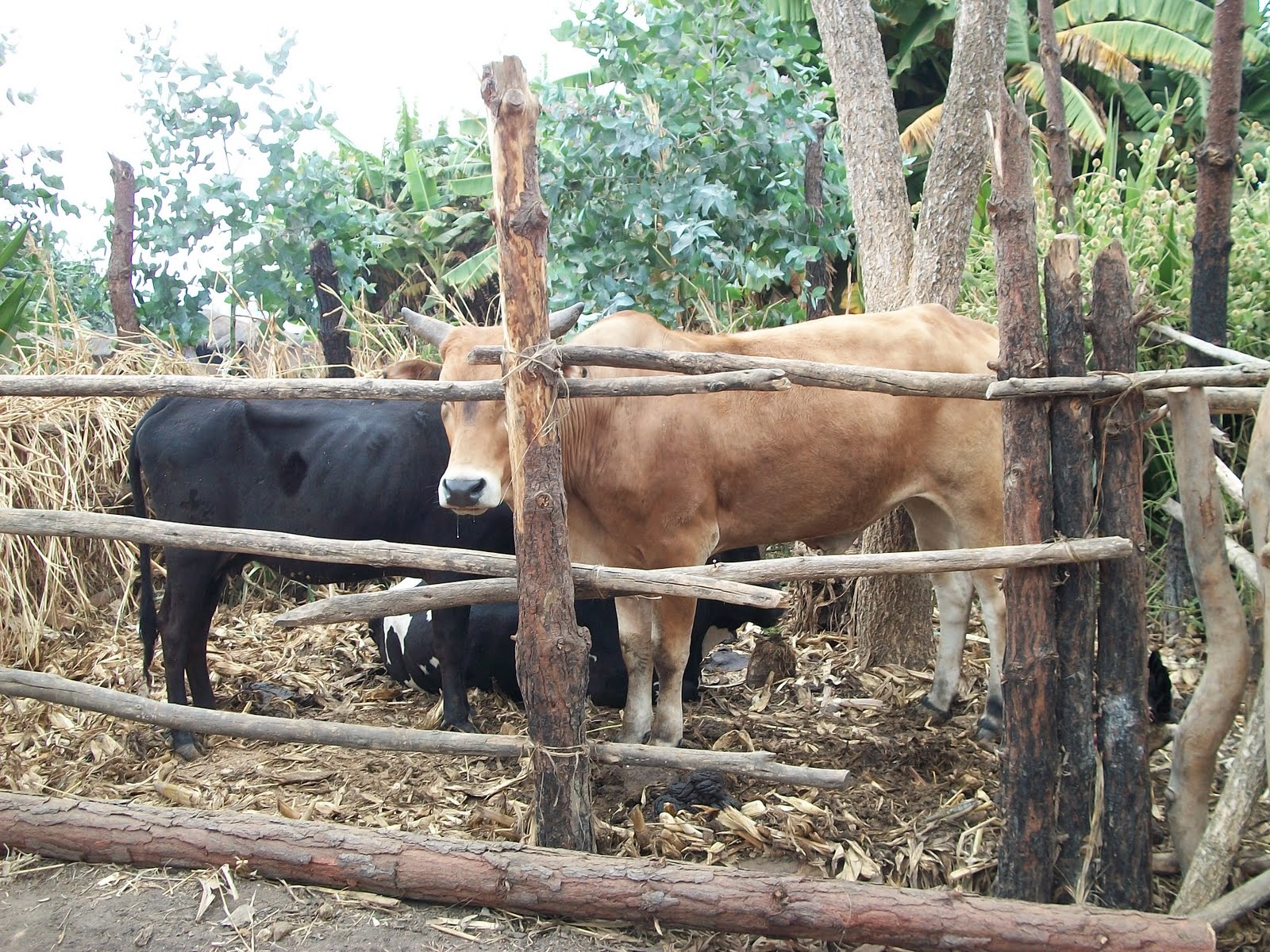
The Jika's cows.


The Jika's hog.


Adorable piglets resting in the sun.


My clothes on the clothesline. 


The village farewell ceremony.  The Chipazi women are dancing.  My amayi is the one with the American flag socks on. 


A dancer in the "Guliwonkulu" (big dance) in Malawi.  These dancers are called "animals."  They danced for our village farewell ceremony.


Another dancer.


I think this guy is supposed to be an owl.


More dancers.


This was the finale - a two person goat costume.

Wednesday, June 30, 2010

Next Post

I may not be able to access the internet until I complete training on September 1.  I will write letters and look forward to updating this blog as soon as possible.

Tuesday, June 29, 2010

Welcome Letters: Daily Life


The following excerpts are from Volunteers who currently serve or recently served in Malawi.

"In no time you'll be able to use a chimbudzi (pit latrine) with the most accurate aim, master the art of bucket-bathing, and prepare your favorite American dish over a three-stone fire." - Jake Farnum

"I remember hearing this and not believing it, but it's true: You don't need to pack a lot of clothes.  You can always get things here (especially if you love the adventure of open-air thift shopping).  Also pack tons of underwear, a swimsuit, and that one outfit that makes you feel 100 percent cozy and 100 percent you."   - Patricia Wundrow

        "The intensity that I experience here on a daily basis is much stronger than anything I could have imagined nine months ago, when I too held a Peace Corps manual in my hands and tried, somehow, to prepare.  But there is a lighthearted side to all of this, also.
        Malawians, as a whole, are very friendly, happy people.  We are always laughing - at and with each other.  Everything that I say is listened to and everything I do is observed.  Everything.  This is part of being a Volunteer in Malawi.  Just as I laugh out loud when I pass a muscular young man wearing a frilly pink T-shirt that says 'Mom to be,' I hear people laughing at me.  What am I wearing or doing that seems so humerous to these people?  Have I become such an odd creature overnight?  No.  I am just a person from another country that is very, very foreign to my new friends and neighbors.  When we discuss 'America' they shake their heads and say: 'Ah, it is a very strange place, madam!'" - Debbie Gordon

"Your life will probably be much more relaxed now.  My days revolve around clean laundry and going to buy vegetables.  Life is calm and happy in Malawi." - Naomi Bremer

"The people in my community have been my family; we have laughed together and we have cried together.  The chiefs and the villagers around Vwaza have been my friends; we have planted maize together, harvested termites and caterpillars together (and then we ate them), and searched for shooting stars together.  And the children are my entertainment; some of my best memories are sitting on the stoop outside my hut chatting with 'my Kazuni kids' under a full moon."  - Stephanie Jayne

Welcome Letters: Life Issues


The following excerpts are from Volunteers who currently serve or recently served in Malawi.

         "Think about the images that you have of Africa and where they come from.  The media often gives us a very skewed and negative perspective of African life with its portrayal of wars, pestilence, disease, famine, or starvation.  What we don't often see is what you will experience by living in Malawi.  It is a peaceful and wonderful place to call home.  The larger cities have the things that you would find in America... grocery stores, Internet services, restaurants, etc.  Day-to-day living comes with its own unique circumstances, and like every country in the world, Malawi is working to address the problems it faces.
         Your skills as a Peace Corps Volunteer can be a valuable contribution to the country's progress.  If you are willing to avoid making opinions of life in Malalwi based on Western concepts such as material resources or money, and instead focus on the things that really matter in life, you will quickly realize that you are living in one of the richest countries in the world."   - Kristof Nordin

"Your life will be very different here; face it.  But that's part of the reason you're joining the Peace Corps.  And you're going to go through some changes.  But be yourself, read a lot of good books, write your daily thoughts frequently, take a walk, a bike ride, chat, or play cards, and don't forget why you're here or who you are." - Angie Sanders

"I am representing what people know/think about the United States, so my actions have to be carefully thought out." - Jake Farnum

"AIDS is huge.  You'll see it everywhere.  One of the teachers at my school died during my site visit after suffering for several months.  Perhaps you should study up on HIV/AIDS before you come and be prepared to help educate your community." - Allison McGough

"As I prepared to enter the Peace Corps, I heard various stories about life in Africa for African Americans.  Some positive, some negative.  Well, I probably have a slightly different cut from any of the stories.  I have uncovered a special sense of pride in being African American.  It is now clear that though I am of African heritage, in the absence of tribal and/or country identity, that heritage doesn't mean much to anyone except me (and other Americans).  But as I am more conscious that I am 100 percent American, it does not trouble me to not know the particulars about something I cannot know.  Instead, perhaps it gives me a special flexibility." - Ella Lacey

"Malawi may be the 'Warm Heart of Africa' but it sure isn't for the 'Faint of Heart!'" - Patricia Wundrow


Monday, June 28, 2010

Welcome Letters: Getting Started - Training


The following excerpts are from Volunteers who currently serve or recently served in Malawi.  These excerpts are about the training period, which I will go through from July 3 - September 1.

"An overwheming period - new culture, new language, and new people.  Living with the host family is as hands-on as it gets in order to practice everything learned.  An opportunity to get to know your fellow Volunteers, because soon after, you may be a two-day mini-bus ride away from each other." - Jake Farnum

"Don't worry about the language - you'll learn it.  Don't worry about the culture - you'll find a way to accept it, and it will accept you.  Malawi is a wonderfully welcoming place and you'll grow to love it!  It is a good idea to bring some fun things to do with your host family like Frisbee and cards, and pictures of America and your family to share." - Laura Lanwermayer

        "It is important to remember that the 'Getting Started' process may seem slow by the standards that you have set for yourself.  It is normal to enter your time of service with a lot of enthusiasm, energy and willingness to 'get things done.'  Keep in mind, however, that you will also need to have an initial period of gaining the trust of your community, adapting to a new culture, and learning a new language.  These things take time and patience, but they are essential to a successful assignment.
        Your pre-service training will help you to gain the skills that will be necessary for this process.  If it feels like the beginning of your service is getting off to a slow start as far as 'work' is concerned, remember that you are doing some of the hardest and most important work of your two years.  When you enter your community, take the time to learn about yourself and those around you.  It makes a world of difference, and eventually it can make a difference in the world." - Kristof Nordin

"Training prepared me well for life in Malawi, especially living with my host family.  This is a very intense period.  Before I left the States, I left self-addressed stamped envelopes with my family and friends and stressed how much mail I'd need at first.  Don't expect to be in touch with people via telephone during this time." - Naomi Bremer

"Brace yourself.  Training is a challenge!  But...your days with your village family are a once-in-a-lifetime experience and will form some indelible memories.  How will I ever forget that one evening when my village family and I playfully balanced mangoes on our heads while walking home along the dusty path in the fading colors of the day?  Believe me, the challenges are well worth the journey.  Just open yourself to the experience, let it happen, and you'll know what I mean."   - Patricia Wundrow       

Geography and Climate


Malawi is south of the equator, so the seasons are opposite of those in the United States.  In June, July, and August the temperatures range from 35 degrees F in the higher elevations to 60 to 70 degrees near the shore of Lake Malawi.  The hottest months are October, November and December.  Temperatures range from 70 degrees F in the high elevations to around 90 to 95 degrees F in the lower elevations.  The rainy season starts in November or December and lasts through April.  The rest of the year is quite dry, although rain showers are possible throughout the year. 

The geography of Malawi is dominated by Lake Malawi, which stretches down most of the eastern side of the country.  The lake is a beautiful setting for many activities and also provides approximately 85 percent of the fresh-water tropical aquarium fish in the world.